



The psychology of investing, and why self knowledge matters more than any market forecast.
Ask most people what threatens their investments and they point outward. A market crash, a recession, a poor quarter, a headline from the other side of the world. Those things are real, and we spend considerable time thinking about them.
But after years in this work, I have come to believe something less comfortable. The greatest risk to your long term results is usually not out there in the market at all. It is the person in the mirror.
This is not a criticism, and I include myself entirely. It is the most human thing in the world. Our minds were built for an altogether different set of problems than the ones investing presents. They were tuned over a very long time to react quickly to danger, to move with the herd, to feel a loss far more sharply than an equivalent gain. Those instincts kept our ancestors alive. They also make us our own worst adversary the moment markets turn emotional.
Why losses hurt more than gains please
Consider loss aversion. Research has found consistently that the pain of losing money registers roughly twice as intensely as the pleasure of gaining the same amount. Sit with that for a moment, because it explains a great deal. It is why a falling market feels unbearable while a rising one barely registers. It is why someone who has patiently held an investment for years will sell it in a single afternoon, locking in a real loss simply to make the discomfort stop. The arithmetic says wait. The body says run. The body usually wins.
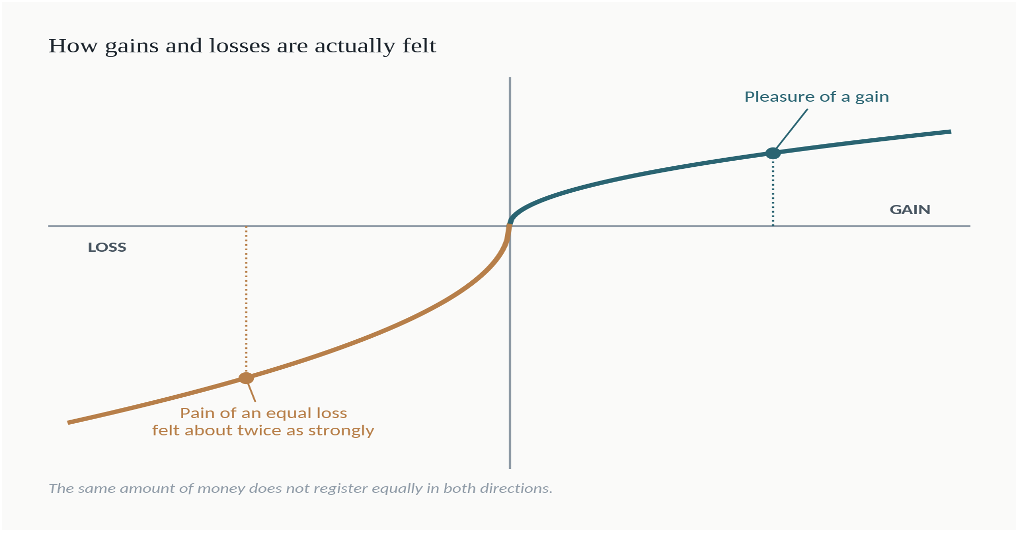
Losses and gains of equal size are not experienced as equal. This asymmetry drives a great many poor decisions.
Or consider recency, which is subtler and in some ways more dangerous. We quietly assume the recent past will continue. After a long climb we feel invulnerable and accept more risk than we should, precisely when prices are least forgiving. After a long decline we become certain the pain will never end and retreat to cash, often just before recovery. What makes recency so effective at deceiving us is that the story we tell ourselves always sounds reasonable in the moment. We are not conscious of feeling anything. We simply believe we are being sensible. Only in hindsight, sometimes years later, does the pattern become uncomfortably clear.
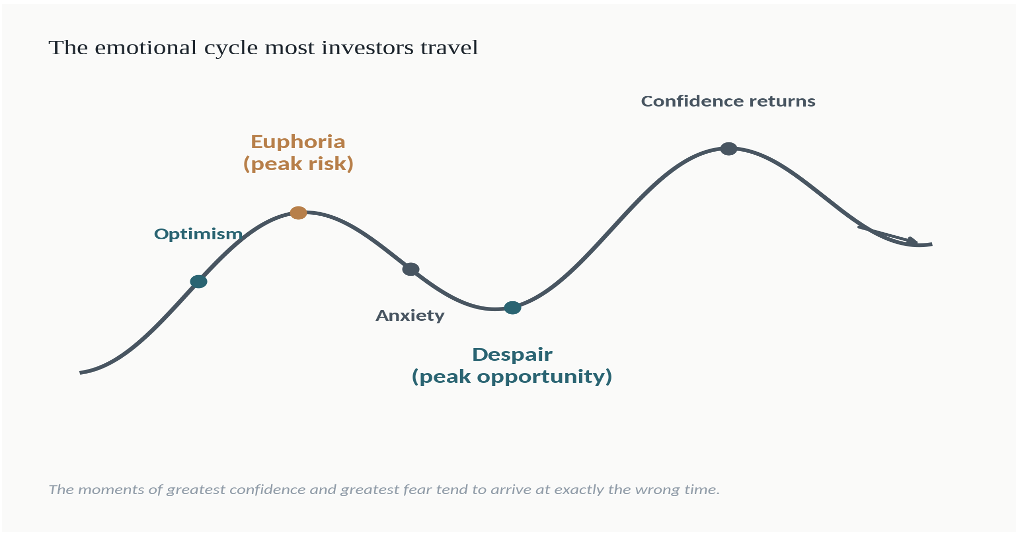
Conviction tends to peak when risk is highest, and collapse when opportunity is greatest.
Intelligence offers no protection
Here is the part I find genuinely fascinating: intelligence offers almost no protection. Some of the most accomplished people I have met make deeply emotional decisions with their money. Engineers, surgeons, business owners who built something remarkable from nothing. Being clever does not help, because these forces do not operate at the level of logic. They operate beneath it. Knowing the tide is there does not stop it pulling at your legs.
I learned this about myself before I learned it about anyone else. Early in my career I could recite every behavioural bias in the literature and still feel my stomach drop when a position moved against me. Knowledge and feeling occupy different rooms in the same house. Anyone claiming to have transcended this is either not being candid or has not yet been tested hard enough.
What actually helps
It is not greater willpower. Willpower is precisely the resource that fails under stress, which is exactly when it is needed. What helps is self knowledge, built before the storm rather than during it. If you understand your own tendencies, where you are prone to panic, where you are prone to greed, which particular kind of market will test you most, then you can build a plan that accounts for the real you rather than an idealised version who does not exist.
This is why we care so much about understanding how each client is actually constituted, not merely what return they say they want. Two people with identical finances, identical ages and identical goals can require entirely different portfolios, because one will sleep soundly through a twenty percent decline and the other will not sleep at all. A plan that is theoretically optimal but which you abandon at the worst possible moment is not a good plan. It is a plan that has not yet met you. The right portfolio is the one you can live with when things become difficult, and that is a question about you, not about markets.
There is an older idea worth borrowing here, one that appears in nearly every contemplative tradition: that the work of understanding the world and the work of understanding yourself are not separate tasks. Whatever you have not examined in yourself will eventually make your decisions for you. Markets are unusually efficient at revealing which parts of us remain unexamined, and they tend to present the invoice at the least convenient moment.
This is a large part of what we believe a good advisor is actually for. Not to predict markets, which no one does reliably over time, whatever the marketing suggests. But to be a steadying presence at the precise moments your instincts are urging the wrong course. To ask, gently and without judgment, whether the decision you feel so certain about is arriving from your plan or from your fear. Sometimes the honest answer is fear, and naming it aloud is enough to break the spell.
The investors who fare best over a lifetime are rarely those with the cleverest strategy. We have watched brilliant strategies undone by ordinary human panic, and we have watched unremarkable, sensible portfolios compound quietly into real wealth because their owner understood themselves well enough to remain seated.
That, far more than any market forecast, is where returns are genuinely won and lost. Not in the market. In the mirror.