



Investing in a changing world order, and why the response is not prediction but preparation.
I have lived in five countries across four continents and speak five languages, most of them imperfectly. I mention it not as a credential but because it granted me an education I never asked for, one that has quietly shaped how we invest.
When you grow up moving, you learn early that the things people treat as permanent are not. Currencies that everyone trusted become something you spend quickly, before they lose value. Borders that seemed fixed get redrawn. Institutions that felt eternal turn out to have been a particular arrangement, made by particular people, at a particular moment. For those who spend a whole life in one stable country, these arrive as news stories. For me they arrived as changes of address.
That is not a lament. It is simply a different starting assumption. Most investors, quite reasonably, assume the world will continue working the way it has worked throughout their adult lives. I have never quite been able to assume that, and it has proven a useful disadvantage.
The operating system we stopped noticing
For most of our lifetimes, the world has run on a familiar operating system. One dominant power, one reserve currency, one broadly agreed set of rules governing trade and finance. It has been stable enough that most investors never had to think about it at all. You could keep your money close to home, in familiar names, and do perfectly well. The system was so reliable it became invisible, the way one does not notice the floor until it moves.
That order is now being renegotiated. Not overnight, and not through any single dramatic event, but steadily, the way these things always happen. Power is dispersing rather than concentrating. New trade relationships are forming that route around the old centres. Central banks worldwide have been accumulating gold at the fastest pace in decades, which is less a prediction than a hedge, a quiet acknowledgment that they would prefer to depend a little less on any single country’s promises.
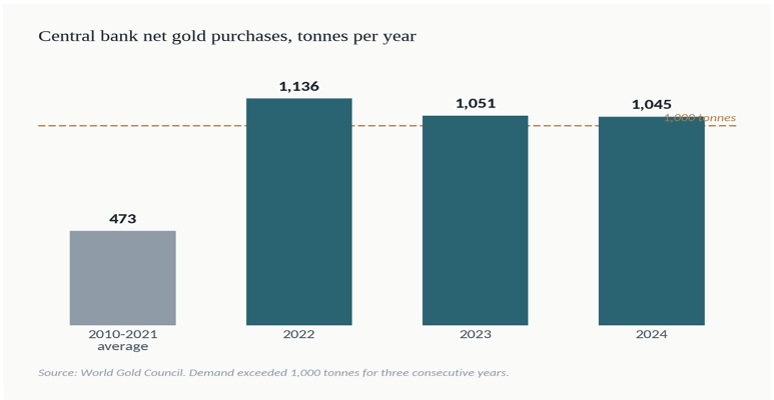
Central banks have bought more than 1,000 tonnes of gold in each of the last three years, roughly double the pace of the previous decade.
We should be careful here, because this subject attracts a great many loud voices predicting collapse, and we are not among them. Those voices have been wrong for decades and will be wrong again. Not because the shift is unreal, but because they consistently mistake slow structural change for imminent catastrophe. There is a great deal of money to be made selling fear, and almost none of it ends up with the frightened.
What is actually underway is slower and, we would argue, more consequential than any crash narrative. The ground is not giving way. It is tilting. A tilt is far harder to notice than a collapse, which is precisely what makes it worth discussing.
The quiet risk of feeling at home
Most of us hold portfolios heavily concentrated in our own country and our own currency, simply because it feels safe and familiar. Economists call this home bias, and every nation exhibits it. Canadians hold too much Canada; Americans hold too much America. It is not foolishness, it is comfort, and comfort exerts real force over financial decisions. In a stable, single-order world, that bias costs little. In a world that is reordering, concentration in any one place, however comfortable, becomes a quiet risk that does not announce itself until it matters.
The response is not to guess which country prevails. We do not know, and we are deeply suspicious of anyone who claims to. Twenty years ago the confident answer would have been one thing; thirty years before that, something else entirely. Both would have proven wrong in ways nobody anticipated. Forecasting geopolitics is a humbling business.
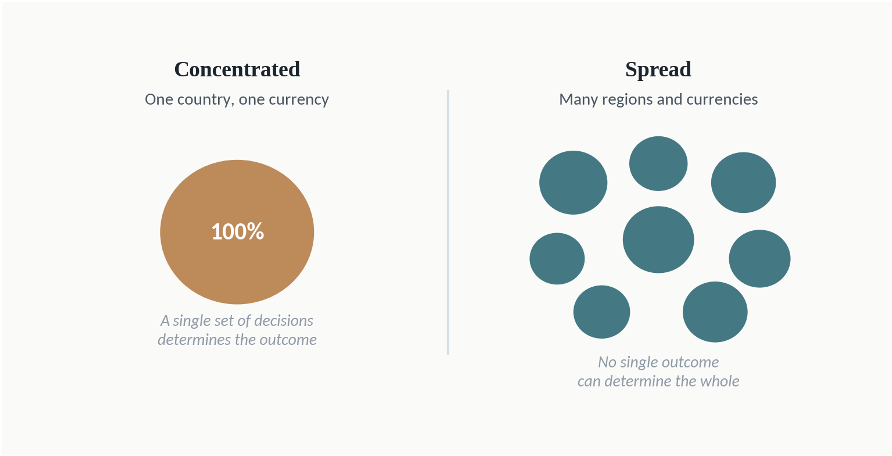
The aim is not to predict which region prevails, but to build a portfolio that does not depend on the answer.
The response is to spread your footing. To own quality across different regions and currencies, so that no single government’s decisions determine your outcome. To hold some real assets that retain value when paper promises waver. To construct a portfolio that does not require any one prediction to come true in order to do its work. That last sentence is, honestly, most of our investment philosophy in a single line.
Packing for weather you cannot predict
There is a version of this article that would end on anxiety. We do not feel anxious about it, and it is worth explaining why.
A few years after arriving in Canada, someone took me up to Algonquin Park and taught me about backcountry camping. If you have done it, you know the entire discipline consists of preparing for conditions you cannot predict. You do not get to know what the weather will do. You pack for the range of things it might do, carry slightly more than you think you need, and then enjoy the trip. The preparation is not what makes it stressful. The preparation is precisely what allows you to relax.
That is how we think about a portfolio built for a changing world. Not braced for disaster, but prepared broadly enough that being right about direction becomes unnecessary.
And there is genuine cause for optimism. A more multipolar world is also a world with more places where growth, innovation and human energy can take root. Regions peripheral to the old system are becoming central to the new one. Hundreds of millions of people are entering the middle class in places to which most Western portfolios have almost no exposure. That is not a threat to be defended against. It is an opportunity to hold a stake in.
Our work is to ensure you own a piece of that broader world, thoughtfully, without chasing headlines or overpaying for the privilege. The order is changing. Portfolios should be built to stand steady while it does, and to participate in whatever follows.